Fostering Group Work in Virtual Reality Environments: Is Presence Enough?
Ayushi Tandon, Yogini Joglekar, Sabra Brock
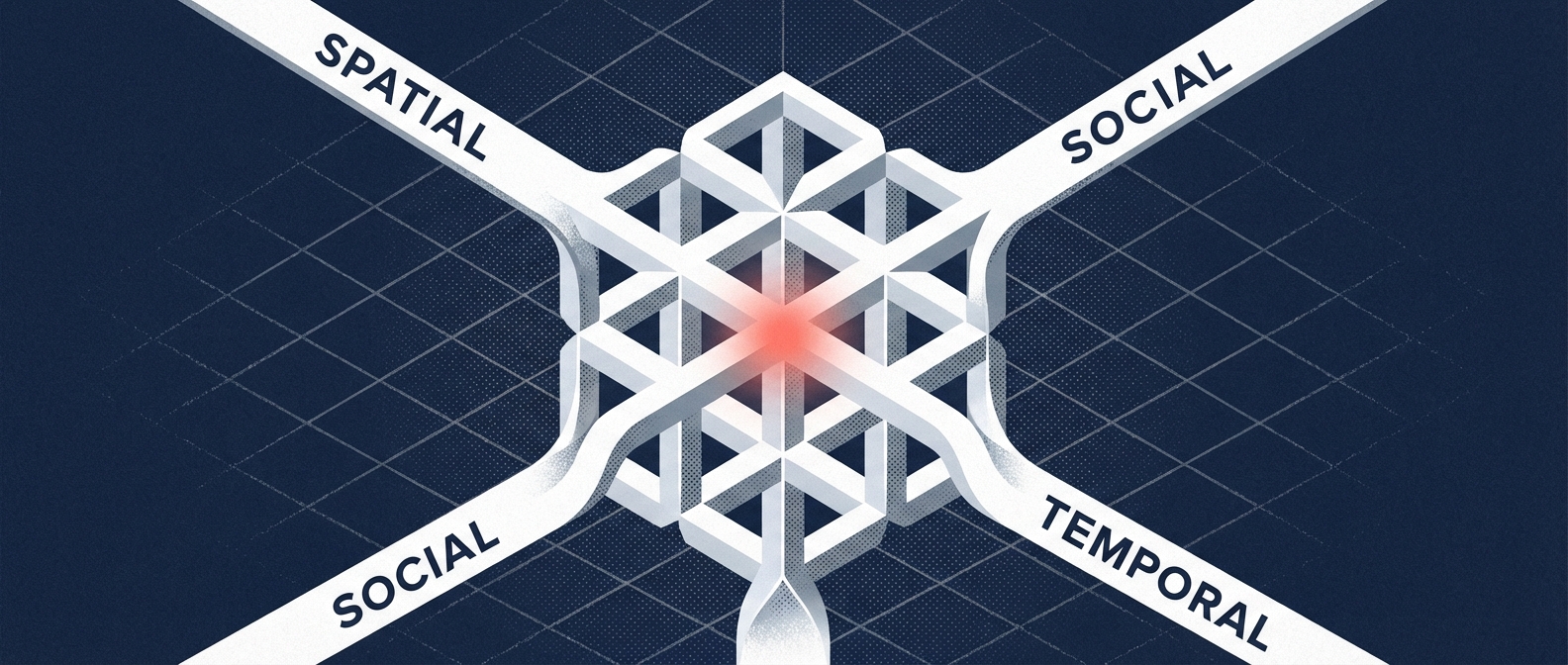
This study investigates how working in Virtual Reality (VR) affects group collaboration in a professional development setting. Using Construal Level Theory as a framework, the research qualitatively analyzed the experiences of participants in a VR certification course to understand how feelings of spatial, social, and temporal presence impact group dynamics.
Problem
Most research on Virtual Reality has focused on its benefits for individual users in fields like gaming and healthcare. There is a significant gap in understanding how VR technology facilitates or hinders collaborative group work, especially as remote and hybrid work models become more common in professional settings.
Outcome
- A heightened sense of 'spatial presence' (feeling physically there) in VR positively improves group communication, collaboration, and overall performance. - 'Social presence' (feeling connected to others) in VR also enhances group cohesion and effectiveness at both immediate (local) and long-term (global) levels. - The experience of 'temporal presence' (how time is perceived) in VR, which can feel distorted, positively influences immediate group coordination and collaboration. - The effectiveness of VR for group work is significantly influenced by 'task-technology fit'; the positive effects of presence are stronger when VR's features are well-suited to the group's task.
Host: Welcome to A.I.S. Insights — powered by Living Knowledge. In a world of remote and hybrid work, we're all looking for better ways to connect and collaborate. Today, we're diving into the world of Virtual Reality to see if it holds the key. I’m your host, Anna Ivy Summers. Host: With me is our analyst, Alex Ian Sutherland, who has been digging into a fascinating new study on this very topic. Welcome, Alex. Expert: Great to be here, Anna. Host: The study is titled "Fostering Group Work in Virtual Reality Environments: Is Presence Enough?". In a nutshell, it investigates how working in VR affects group collaboration and how that feeling of ‘being there’ really impacts team dynamics. Expert: Exactly. It's about moving beyond the hype and understanding what really happens when teams put on the headsets. Host: So Alex, let’s start with the big picture. We have tools like Zoom and Teams. Why is there a need to even explore VR for group work? What’s the problem this study is trying to solve? Expert: The core problem is that while VR is booming for individual uses like gaming or specialized training, there's a huge gap in our understanding of how it works for teams. Expert: We know 2D video calls can lead to fatigue and a sense of disconnection. The big question the researchers asked was: can VR bridge that gap? Does the immersive feeling of 'presence' that VR creates actually translate into better group performance, or is it just a novelty? Host: A very relevant question for any business with a distributed team. So, how did the researchers go about finding an answer? Expert: They took a really practical approach. They studied several groups of professionals who were taking part in a VR instructor certification course. Over several weeks, they observed these teams working together on projects inside a virtual campus, collecting data from recordings, participant reflections, and focus groups. Expert: This allowed them to see beyond a one-off experiment and understand how team dynamics evolved over time in a realistic professional development setting. Host: It sounds very thorough. So, after all that observation, what were the key findings? Is presence enough to improve group work? Expert: The findings are nuanced but incredibly insightful. The study breaks "presence" down into three types, and each has a different impact. Expert: First, there’s 'spatial presence'—the feeling of physically being in the virtual space. The study found this is a huge positive. When teams feel like they're actually in the same room, sharing a space, it significantly improves communication and collaboration. Host: So it’s more than just seeing your colleagues on a screen; it's about your brain believing you're sharing a physical environment with them. Expert: Precisely. The second type is 'social presence'—that feeling of being connected to others. In VR, this was enhanced through shared experiences and even the use of avatars, which can make people feel more comfortable giving honest feedback. This directly boosted group cohesion and trust. Host: That’s interesting. And what was the third type of presence? Expert: That would be 'temporal presence,' or how we perceive time. Participants in VR often experienced a "time warp," where they'd lose track of real-world time and become deeply focused on the task at hand. This helped immediate coordination, especially for teams spread across different time zones. Expert: But there’s a crucial catch to all of this, which was the study’s most important finding: task-technology fit. Host: Task-technology fit. What does that mean in this context? Expert: It means VR is not a silver bullet. The positive effects of presence are only strong when the task is actually suited for VR. For creative brainstorming or hands-on simulations, it's fantastic. But for tasks that require heavy note-taking or documentation, it's inefficient because you have to constantly switch in and out of the headset. Host: This is the critical part for our listeners. Let's translate this into action. What are the key business takeaways from this study? Expert: I see three major ones. First, rethink your training and onboarding. VR offers an unparalleled way to create immersive simulations for everything from complex technical skills to soft skills like empathy training for new managers. It can make remote new hires feel truly part of the team from day one. Expert: Second, it can supercharge collaboration for global teams. For those crucial, high-stakes brainstorming or problem-solving sessions, VR can bridge geographical distance in a way video calls simply can't, fostering a real sense of shared purpose. One participant working with colleagues in India and California said they "met with really no distance amongst us." Host: That’s a powerful testament. And the third takeaway? Expert: Be strategic. Don’t invest in VR for the sake of it. Understand its strengths and weaknesses. Use it for immersive, collaborative experiences that play to its strengths. For a quick status update or writing a report, traditional tools are still more efficient. The key is to choose the right tool for the job. Host: So, in summary: Virtual Reality can be a powerful tool to foster genuine connection and collaboration in distributed teams, largely because of that heightened sense of presence. Host: But it's not a one-size-fits-all solution. The real magic happens when the immersive capabilities of the technology are perfectly matched to the team's task. Host: Alex, thank you for breaking down this complex topic into such clear, actionable insights. Expert: My pleasure, Anna. Host: And thank you to our audience for tuning in to A.I.S. Insights — powered by Living Knowledge. Join us next time as we continue to explore the intersection of business and technology.